It is time to start Bloom Thyme Fridays even though I am currently sitting in my potting shed while the weather channel is issuing extreme weather warnings … flooding, gale force winds and dropping temperatures.
Several garden friends have asked if I will give regular updates on what is going on in the garden especially since so many of the roses and their companions were effected by the Polar Vortex kind of winter we had. I will post an article on Fridays sharing what is going on in the garden—Bloom Thyme Friday!
Today on my list is to get the barefoot roses that were delivered this week soaked in Moo Poo Tea and ready to plant on Sunday — if the weather predictions are true and the weather is much better on Sunday.
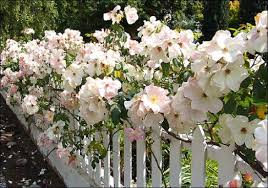
Last Sunday I was able to plant two new roses: Climbing Colette and Sally Holmes.
Climbing Colette
Colette comes to us from our great rose friends at Star Roses and Plants. I purchased Colette from S & W Greenhouse and received a very healthy barefoot plant.
I also surveyed my Rose Chat friends on Facebook who grow Colette to get their opinions.
Here are some of their responses.
Colette is a Beauty!
We just planted one yesterday for a client of ours with four pillar roses in a row growing on upright trellises. Totally lovely.
Light color roses usually need afternoon shade here in SoCal.
I have this rose, it’s very fragrant and looks like an old fashioned rose with so many petals. It was also very fast growing and had flowers all the way up, not just at the top like a lot of climbers. I did find that the heat took a toll on it here in CA. I might recommend afternoon shade based on my experience with it.
This beauty is Sally Holmes, a Hybrid Musk…
Hybrid Musks are a small but very hardy group of roses and Sally is one of the most popular! I have another Hybrid Musk, Francis E. Lester. You can read about him here.
Sally was introduced in 1976 and has been the recipient of countless awards. Every picture I see of Sally is breathtaking—huge 3 1/2″ blooms. I read these blooms are as fragrant as they are beautiful. I am so looking forward to having Sally in my garden. I planted her near my Potting Shed so I could enjoy her up close and personal!
Other details…
Shade Tolerant
Very few thorns
Zone 5 – 9
6’ high (or up to 12’ if trained as a climber) and 4-5’ wide
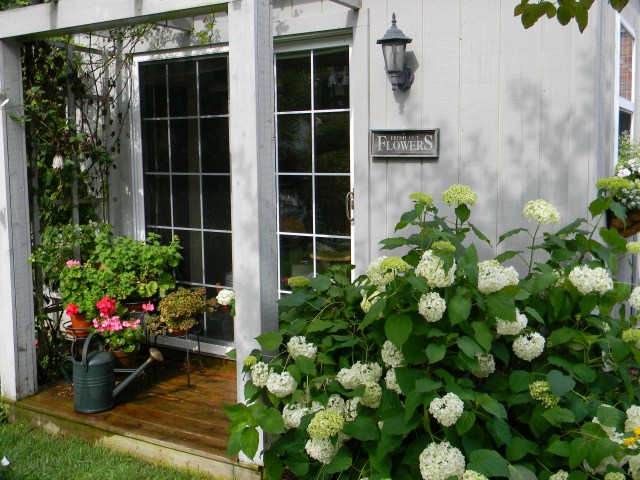
The Potting Shed on a much warmer day!
I hope you are having a lovely day regardless of the weather. Even in the storms we see the beauty and creativity of God’s handiwork and get a glimpse of His power too!
So from my Potting Shed on a very cold, stormy day I wish you a very happy BLOOM THYME FRIDAY!
The Polar Vortex has come and gone, although I did see that there is a bit of snow in the forecast for next week. So, those of us who thought the weather might be stuck in winter mode can now relax and begin to enjoy spring and breathe!
This morning I was out early assessing the damage and trimming back some very black rose canes.
Here’s what I can tell you so far:
THE ROSES….
Roseraie de la Hay
The old roses wintered the horrible weather just fine. I’m not sure they even knew we had a Polar Vortex. There are bud eyes (Bud eyes are swellings on the cane where the growth will start.) right to the very tips. Roseraie de la Hay, Harison’s Yellow, Rosa Mundi, Celsiana, Hansa, Madam Hardy and the others look amazing! No die back at all.
Peach Drift
Drift Roses have had a little die back, as they normally do.
Knockouts will need to be cut back severely, but I always do that anyway!
Hybrid Teas and Floribundas will be cut back to around 4”. That is a few inches lower than I normally would prune them. Most years I prune them down to 12”.
The new roses on the amazing trellis Mr. G built, Francis E Lester and Peggy Martin, have had quite a bit of die back but they are out in the open and susceptible to wind, so it is not surprising.
I’m still not sure about my New Dawn and Zepherine Drouhin climbers but the Golden Gate climbers will be cut back to about 12”.
Fall plantings…
I completely covered the roses that I planted or transplanted last fall in mulch, and to my surprise when I pulled back the mulch to check on what was going on under the mulch, the roses were green to the point of leafing out. 🙂
THE COMPANIONS…
Daylilies, yarrow, daffodils and iris are all up and doing fine.
Perennial herbs are right on schedule.
Annabelle and Pinky Winky hydrangeas look amazing.
For lavender and many other companions, it’s too early to tell.
Bloomerang lilacs look ready to rock and roll.
Dogwood trees, minus a few limbs that we lost in the heaviest of the snows, are loaded with buds.
To say I am pleased is a huge understatement. There were many bitterly cold, windy days that I feared the worst for the garden. So grateful for the blanket of snow!
And, if Rose Midge was eliminated in all that cold and ice… well, that will be something to celebrate too.
As more cold weather is coming this week, I’ll keep you posted. Fingers crossed that the temps don’t dip toooo low. But, I think I can safely say that the Polar Vortex was kinder to my garden that I ever dreamed!
My garden last spring…
I hope spring is shaping up nicely in your neck of the woods and you are able to enjoy God’s handiwork! Is there anything more wonderful for a gardener to experience than the rebirth of spring!
Okay if you are the geeky, grammar type like me and thought there was a typo in my title because I left out the S at the end of Saving, I have to tell you it really is officially Daylight Saving Time. I know. I know. It just sounds wrong. But, in my humble opinion, there is nothing wrong with DST. I just love it. It allows me a whole extra hour of daylight to work in the garden after work, so I’m all in for DST.
THE POLAR VORTEX
The Polar Vortex has left us winter weary around here. We have had a record-setting 50-something inches of snow. And, even though it is still lingering, it is soon to be history! Warmer temps are coming and I am in full spring-fever mode.
First up this spring will be to assess the damage left by our winter companion, Mr. Polar Vortex. My quick tour of the garden last week encouraged me as I saw a great deal of green at the base of the roses I could see. (Some were still snow covered.) So, I think they are going to have a slow but sure start. Roses are not the “Prima Donnas” some think them to be.
I am often asked what I do in the spring to “all those roses.” So here are some tips that I follow for getting my roses off to a good start.
1. PLANT ING
For early April planting, I buy bare root roses from online vendors. (Click here for a list of rose companies.) When they arrive they are “bare roots” wrapped in wet newspaper and plastic. Very humble beginnings for a plant that will be so lovely later!
Bare roots soaking in Moo Poo Tea…
I immediately unpack them and soak them in a bucket of Moo Poo tea for 24 hours before planting. Click here for a great video on planting bare root roses by Guinivere of Roses of Yesterday and Today.
Planting decisions are dependent on the type of rose…
Grafted Roses: Most hybrid teas, floribunda and grandifloras are grafted roses.
This means that a rose is created by being grafted onto strong, hardy root stock, creating a “bud union.” Plant the bud union (knobby part just above the roots) 3” below the soil line to protect it from harsh winters.
Own Root Roses: Roses that have not been grafted but were started from cuttings, so there is no bud union to protect. In the past I have always planted them as I would any other shrub (to the same depth as they are in the pot they were growing in), however, after such a harsh winter, I now plan to plant even the own root roses about 2″ below the soil line for some extra protection.
Soil: We ask roses to bloom for us all summer, year after year, so it is best to give them a good start by planting them in good, rich soil. Our neck of the woods has horrible gray clay soil so we dig BIG holes–holes much deeper and wider than the root system to allow for soil amendments and deep enough to protect the bud union. To the soil removed, we add compost and a quality grade of top soil. Your roses will appreciate your gifts of more nutrients and better drainage and will reward you handsomely! You will never regret giving your roses a good start.
2. PRUNING
It is difficult to know when winter is really over and it is time to prune, so I let the forsythia tell me. When the forsythia is blooming, I start pruning. All you need are protective gloves and a sharp pair of pruners. I must have been very good because Santa brought me a pair of Bionic Gloves and Barnel Pruners from Wendy Tilley, owner of The Rose Gardener Garden Shop and Harlane Garden Labels. Maybe Santa listened to our Rose Chat Podcast with Wendy. You can listen to Wendy too. Just click here.
Gene Boerner Floribunda
Pruning tips for different types of roses…
Hybrid Teas: For hybrid teas, I shape, cut out any dead wood and remove the canes that cross the middle to create more air circulation in the center of the plant which can help control fungal disease. These roses I will cut back to about 10 – 12″ high to give them a strong start. If you are going to exhibit roses in a rose show, there are some other tips you will need and the American Rose Society website is filled to the brim with excellent information.
Old Garden Roses: To me bigger is better as far as old garden roses are concerned so I do very little pruning. For one-time blooming roses, do not prune until after they bloom! And, when you prune, just thin out old wood, remove any dead wood and spindly canes.
David Austin English Roses: Very little pruning is required as they don’t appreciate a lot of cutting, just remove dead wood and give them a light shaping. Except in the case of some of the ones that tend to get very tall, like Graham Thomas, I prune those down farther to keep them within bounds.
Sunny Knock Out Rose
Shrub/Landscape Roses: These are so easy… Just shape to fit your space. I have several Knockout and Drift roses and I usually trim them back about 1/2 their size in the spring, but it is not required. I often give them another hard pruning in mid summer to refresh them into another spring-like bloom cycle in early fall.
3. FERTILIZE
After I prune my roses I apply fertilizer. Most any fertilizer will do—but do read labels carefully–too much of a good thing can be harmful! I use a combination of Moo Poo Tea and Mills Magic Mix on my roses.
4. WATERING
Once the fertilizer has been applied you will want to give your roses a deep watering to get those nutrients down to where they can do some good. A good rule of thumb is to water at the base of the plant especially if you are watering in the evening, as wet rose leaves are more susceptible to fungal diseases (e.g. Black Spot & Powdery Mildew). Although, if I am watering in the morning I give them a good all-over shower. This is great way to remove any aphids that have shown up for the tasty and tender buds! I think roses appreciate a refreshing shower just as we do, just don’t put them to bed wet.
5. MULCHING
This is one of my favorite parts. Mulch is so good for your roses … retains moisture, helps to keep down weeds and gives the garden that fresh, finished look!
One thing to remember when applying mulch … when mulch breaks down, it uses nitrogen in the process, so add a layer of compost on top of the soil before you add the mulch layer then the nitrogen in the soil can be used by the rose. If you are working in an established bed and last year’s mulch is still there, leave it… it becomes a “compost layer.” Win. Win.
My garden…
MY FAVORITE TIP…
My favorite tip is always to visit your roses daily or as often as you can to enjoy their beauty and to get to know them. Getting to know them can be key in early detection of any pest or disease.
And, when you have beautiful roses outside, who can stay in!
From the tiny Tete e Tete to the gigantic yellow trumpets … I have always loved daffodils. They scream spring!!
Daffodils are perennial, increase eagerly and are wonderfully deer and rodent proof.
Four years ago they became even more important to me. We lost a beloved family member on March 19, just as the daffodils were blooming. Uncle Tony (Mr. G’s brother) heroically battled cancer for 20 years. At 49 years of age, it was much too early to lose him. Uncle Tony was a rare and special person … extremely creative, rock solid in his faith, a lover of people, a gardener AND a lover of spring & daffodils.
Just before his death when we were visiting with him, he mentioned wanting to get out in his garden and in particular wanted to see the daffodils blooming. That did not happen.
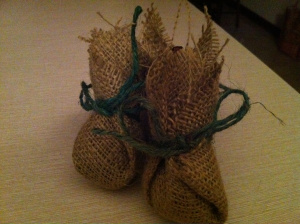
In the fall of that year, I individually wrapped hundreds of daffodils in burlap, tied them with a jute bow and gave them away to anyone who wanted to plant daffodils in Tony’s memory and so many did!
Each year people give me reports on Tony’s daffodils and I know he is remembered.
He was just too special to forget.
Here are a couple of favorite family pictures….
Uncle Tony, Mr. G and our son Matt when we was about 4Brothers at the beach…
So many of our family memories are tied to plants and gardening. Here are a couple of other posts about family members and gardens…
With all the rosemania going on in our garden this year (we are adding 75 or so roses … I know, I know, it “seems” excessive but several of them were gifts, but more about that later), Mr. G is getting a bit concerned about veggie space. In an attempt to secure a spot for his veggies, he did one of the things he does best—built something out of wood.
Mr. G is a very good garden assistant, but his “real” hobby is wood working. He has built everything from stage sets to thousands of craft items for places like Michaels (remember the tole painting & craft era?!), to school projects for the kids and garden fences & arbors. And, who could forget the potting shed and the dirt drawer?
When a craftsman wants veggie boxes here’s how it goes…
The project started with a trip to Lowes with Mr. Bennet to pick out wood.
Mr G and Mr Bennet
In the wood shoppe there is everything you need to build just about anything with wood… including a laser guided miter saw. (Whatever that is?)
Laser Guided Miter Saw…
Process…
I think veggie plants will be very happy in these beautiful boxes. However, I must say that I think the mini flora roses on the For Love of Roses website I was looking at last night would fit in there very nicely too. But, we won’t talk about that … at this time. 🙂
They can be planted early when you are just itching to do some real “gardening.”
They are beautiful.
They climb and vine on your fence or trellis adding vertical interest.
Most varieties have a sweet fragrance.
They look great in early summer bokays!
Sweet pea seeds have a hard shell, so I am soaking them over night and will plant them tomorrow.
Varieties I am planting this year are all from Burpee…
Moody Blue Mix: Extra large, fragrant blooms in rich shads of navy, ocean blue and rose-pink.
Cottage Mix: Mix of shades of white, cream , pink, rose, scarlet and purple.
Summer Wine: Rich wine-colored blooms on full, medium-height vines.
Eckford’s Mix: Very fragrant, large blooms in a wide color range.
Word of caution…
Even though they are called a “pea,” they are NOT edible.
Denise Schreiber in her book Eat Your Roses shares about herbs and flowers that are edible and those that are NOT edible. If you haven’t seen Denise’s delightful book, take a look HERE.
Denise was our guest on Rose Chat Radio a few weeks ago and you can listen to the archived broad cast HERE.
So, tomorrow I will do some of that “real gardening” I have been itching to do and plant my sweet peas … just before our next snow storm. 🙂
If you grow sweet peas, do you have a variety you particularly enjoy?
Other seeds….
Here are a few of my seedlings that are coming along nicely in the potting shed window…
Spring fever is a term applied to several sets of physical and psychological symptoms associated with the arrival of spring says Wikipedia. It isn’t mentioned here, but I can tell you that at my house it includes being so excited that you can’t sleep. And, you should limit reading gardening books too late at night–might cause an adrenalin rush!
It is way too easy for me to get spring fever — regardless of the time of year. I start counting down the days until spring the day after Christmas. So, you could say that today is a day I look forward to most of the year. However, due to current low temperatures, the quote by Hal Borland below is one I am clinging to today…
No winter lasts forever; no spring skips its turn. – Hal Borland
Look at this… the difference between this year and last year …. same week!
But, I am not discouraged …. no, not one little bit. Spring is my friend and I am willing to wait. I’ll be seeing the forsythia and daffodils blooming soon and I’ll be filling buckets with Moo Poo tea to soak those bareroot roses I ordered this winter while I was “patiently” waiting on spring. Soon … real soon. Fingers crossed!
COMING SOON………..
Bare roots soaking in Moo Poo Tea…
Ready and waiting……………
Do you have anything blooming in your garden or are you, like me, “patiently” waiting?
Here’s the frosty news report… Last night I got home in time to assess the damage. Yes, there is some. When you have a garden as large as mine, it is difficult to cover. As much as I have enjoyed the early spring, it sure is hard to see burnt leaves and buds bending down that I know won’t get to bloom. 🙁 I guess you would call me greedy when it comes to blooms.
All in all, the damage is very minimal. The 10-day forecast looks good and includes some much needed rain.
More Roses
Last night I also planted Red Drift Meigalpio Roses as a border for my new bed. (Mr. G actually hung a huge flashlight thingy for me! He is the BEST!) I think the little Red Drift blooms look so cute and will be great to use in arrangements.
Red Drift…
Here’s how they will look when they grow up…
Red Drift® has the most petite flowers of all of the Drift® Roses. It is perfect for use in front of border plantings. Red Drift® makes a beautiful statement when it drapes naturally over a rock wall or edge. Mature height is less than 1½’ with a wider spread. Great flower power and disease resistance.
Frost-free Zone
Things in the frost-free Potting Shed are doing very well! Take a look at the Mortgage Lifter tomatoes (seeds from The Art of Seed)… Actually there are a few peppers in this picture too!
Baby Mortgage Lifters!
Nasturtiums are doing great too…
Nasturtiums to put around my potted tomato plants…
Coming Soon!
Soon the roses will be blooming and I’ll be planting tomatoes. Around here we take roses and tomatoes seriously!
From the look of the Harrison Yellow buds, that rose may bloom in the next few days … and that will be 6 weeks early! 🙂
Frost or no frost, I still love an early spring!
Have you been having frosty mornings in your neck of the woods?
I have many dogwood memories. I grew up in the mountains of Tennessee where the spring is beautiful with azaleas, rhododendron, redbuds and dogwoods. There is nothing quite like seeing the mountains dappled with red, pink, purple and white!
When I was a teenager my dad came home with 8 dogwood trees he had dug in the woods where he had lived as a child. He was so excited about these little samplings. I wasn’t sure. They didn’t look too impressive. I was not sure they would live up to the impressive ones I had seen in the mountains. But, over time I became very impressed! To this day those dogwood trees line my dad’s driveway and are spectacular in the spring. These dogwood trees have brought my family years of pleasure and have brought food and shelter to the many birds there!
When Greg and I moved to our home 26 years ago, we couldn’t wait to plant dogwood trees and through the years we keep adding more. Currently we have 3 very large white dogwood trees, 1 medium sized white and 3 small pink dogwood trees! Funny story… when we bought the last 3, I told the nursery I only wanted white dogwoods. They were not blooming at the time but the tag said, “white.” All of them bloomed pink! And, the nursery went out of business the next year–so pink it is! They are beautiful too but white are still my favorites.
THE LEGEND OF THE DOGWOOD
Have you ever read the Legend of the Dogwood? Although the Bible does not tell us what type of wood the cross Jesus was crucified on was made of, this legend says that the cross was made of dogwood…
In Jesus’ time, the dogwood grew
To a stately size and a lovely hue.
‘Twas strong and firm, its branches interwoven.
For the cross of Christ its timbers were chosen.
Seeing the distress at this use of their wood
Christ made a promise which still holds good:
“Never again shall the dogwood grow
Large enough to be used so.
Slender and twisted, it shall be
With blossoms like the cross for all to see.
As blood stains the petals marked in brown,
The blossom’s center wears a thorny crown.
All who see it will remember Me
Crucified on a cross from the dogwood tree.
Cherished and protected, this tree shall be
A reminder to all of My agony.
Not a part of the legend BUT, in the fall dogwoods produce clusters of red berries and if you look closely you’ll notice that for most of the dogwood varieties the berries are not round but rather shaped like a drop of blood! Hummmmmm
Legends are legends, but I am so grateful for anything that reminds me of His love and sacrifice on our behalf….
“For God loved the world so much that he gave his one and only Son, so that everyone who believes in him will not perish but have eternal life. John 3:16
I hope you have a glorious GOOD FRIDAY.
The white dogwood trees are in full bloom today… Along with the birds in the background you will hear “shots.” Don’t be alarmed, we live near a shooting range! 🙂
 Last Sunday I was able to plant two new roses: Climbing Colette and Sally Holmes.