2014 Rose Introductions: Weeks Roses

This week on the Rose Chat Radio podcast, the delightful Karen Kemp-Docksteader, sales and marketing manager for Weeks Roses, joined us to chat about some wonderful new rose introductions for 2014! Podcast link.

Coretta Scott King
Coretta Scott King

Coretta Scott King Grandiflora Rose
Named for the wife of Dr. Martin Luther King, this rose is not only lovely but very disease resistant. Chris, (The Redneck Rosarian) had an early release of this rose and it has performed beautifully for him this entire summer!

Good as Gold
Good as Gold

Good as Gold Hybrid Tea
A very unusual gold color! Karen said it is stunning in the field and she can hardly pass by it without stopping. This rose is known as a blooming machine!

_YoureTheOne
You’re The One

You’re the One Miniature Rose
Karen pointed out to us that “miniature” does not refer to the growth habit of this rose but rather the blooms are miniature. Isn’t it just so cute! Perfect rose show form!

Jump for Joy
Jump for Joy

Jump for Joy Floribunda
Like its parent, Julia Child, this rose is known for disease resistance and beautiful foliage. This is another blooming machine that will fit well into any landscape.

Happy Go Lucky
Happy Go Lucky

Happy Go Lucky Grandiflora
This beauty has the multi-petaled old rose form with a lovely tea fragrance. I find yellow roses hard to resist so this may quickly go on my wish list!

SNEAK PEAK…

Karen shared with us that it is confirmed there is to be a new line of Downton Abbey Roses. Starting with the first in the series, Anna’s Promise.

Look at this beauty…

Anna's Promise
Anna’s Promise
Anna of Downton Abbey
The beautiful Anna of Downton Abbey

We look forward to having Karen back to talk more about this new line of roses! 🙂

WEEK’S ROSES HARVEST…

Harvest at Weeks Roses begins next week, so follow along with the progress of their work in the fields of roses on their Facebook page. https://www.facebook.com/WeeksRosesCA

Now back to working on my wish list for 2014. How about you, what’s on your garden wish list?

Warning, Potting Sheds Could be Infectious

As you already know, I love my potting shed to pieces. It is a tiny little space, but it does get a lot of attention. I don’t believe any gardener has ever visited my potting shed without saying, “I want one of these!” — unless they already had one! Or a greenhouse which is still on my wish list.

One of those garden-loving visitors who has said over and over and over, “I want one of these!” is my sister. She, like me, loves to dig in the dirt!

I am happy to report to you that this was the year! A move to a new location was decided for several reasons of course, but one of them was the room for a potting shed. And she has just spent her first summer as the owner of a potting shed. But, I know something that she doesn’t yet know–winters are the very best time to have a potting shed. 🙂

Look how cute her shed is…

This slideshow requires JavaScript.

It is easier to face the facts in the potting shed…

Yes, today it is official, I have to face the fact that winter is coming. Even though I have roses that are loaded with buds, the weatherman is saying frost.

So, I am in the potting shed potting up some herbs, bringing in my apple mint (The last garden gift from my mother about 26 years ago and I would never want to lose it! (Read more about that here.), bringing in some geraniums and repotting a rose cutting I was given and want to be sure it makes it through the winter. The rose cutting is Best of ’04 and I don’t want to lose it to “old man winter.” And, hopefully like Beverly did last year, this rose will give me a few beautiful blooms to enjoy.

All the potting shed plants will be given my love and attention and Annie’s Moo Poo Tea, so I think they will be just fine through these long winter months.

Best of ’04

Best of '04
Best of ’04

Best of 04 is a Whit Wells Miniature Rose and is said to be a “Queen Machine” in a Rose Show. I love hearing that. Maybe someday…. 🙂

To read more about this lovely rose and others on the For the Love of Roses website here.

Below is a slide show of my days’ activities and even the view today from my potting shed window. I am so blessed to have a room with a view that I find beautiful regardless of the season.

This slideshow requires JavaScript.

Thanks for stopping by.

If you are like me and garden in areas with long, cold winters, what are you doing to get ready for winter?

Earth Kind

I just received three beautiful roses from Chamblee Nursery–Aloha, Belinda’s Dream and Carefree Beauty. Two of these lovelies are considered Earth Kind roses.

Three New Beauties...
Three New Beauties…

photo 2-4EARTH KIND

Earth-Kind is a special designation given to select rose cultivars by the Texas AgriLife Extension Service through the Earth-Kind landscaping program. It is based on the results of extensive research and field trials and is awarded only to those roses demonstrating superior pest tolerance, combined with outstanding landscape performance.
Read more About Earth-Kind Roses.

Belinda’s Dream

  • Classification: Shrub rose
  • Introduced: 1992
  • Size: Medium shrub (5’X 5′)
  • Bloom: Very double, 100+ petals, up to 4″ diameter. Successive flushes of bloom spring, summer, and fall.
  • Fragrant: Moderate
  • Cold Hardiness: Zones 5-9

I had the great pleasure of seeing Belinda’s Dream in all her glory in the Biltmore Rose Garden a few weeks ago. (Read more about that here.)   This rose had first been recommended to me by Peggy Martin as her favorite rose … especially for those new to growing roses. I am not new to growing roses but I just had to have this lovely rose! Wouldn’t you?

Belinda's Dream in the Biltmore Rose Garden...
Belinda’s Dream in the Biltmore Rose Garden…

You can read more about Peggy Martin and her incredible rose here.

Carefree Beauty_PolCarefree Beauty

  • Classification: Shrub
  • ARS Rating: 8.5
  • Introduction: 1977
  • Color: Light rose
  • Size: 3′ – 4′ 3′ – 4′
  • Cold Hardiness: Zones 4 – 9
  • Disease Resistance: Very
  • Fragrance: Mild

To see other Earth Kind roses, read on.

Her is a fascinating article on Dr. Buck’s life and roses by Julie Jean Gustafson Minot–Dr. Bucks Life.

Other Earth Kind roses I have in my garden that do extremely well are New Dawn and The Fairy.

NewDawn_13_004
New Dawn Spring 2013
The Fairy Rose peaking through the fence.

photo-30

My rose friend, Chris- The Redneck Rosarian, grows Mutabilis and just raves and raves AND RAVES about it. If I had this rose in my garden, I am sure I would rave too!

Here is a picture of Mutabilis in the Biltmore Rose Garden…

Mutabilis at the Biltmore Rose Garden

Peggy Thumb_Pol

Click here to hear Peggy Martin tell her story … From Devastation to Inspiration.

2014 Rose Introductions: David Austin

David Austin English roses with their old world fragrance and form are modern roses that are so reminiscent of the old gallicas, musk and bourbon roses that I love. The English Roses are some of my favorites — mixing old with new is what my cottage garden is all about.

Every year for the past 20 years I get completely giddy when it is time for the new English rose introductions and I am never disappointed. This year’s introductions are exquisite and are promptly going on my wish list!

Take a look…

Boscobel_Pol

Boscobel-a classic English Rose with pretty cupped flowers that evolve over time from deep salmon to deep pink, and a delightful myrrh fragrance with hawthorn character laced with hints of elderflower, pear and almond.

Heathcliff_PolHeathcliff-a brilliant new deep crimson addition to this hard-to-achieve color range, with a beautifully shaped flower and singular fragrance of Tea Rose and Old Rose played off a minor base note of elegant dry woody cedar.

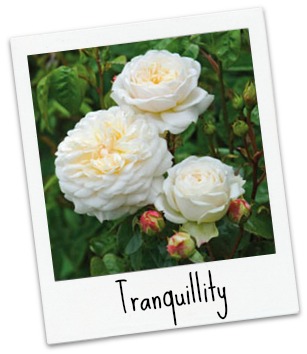
tranquility_polTranquillity-a glistening white rose in a perfectly rounded rosette shape, with a crisp light apple fragrance.

royal_jubilee_polRoyal Jubilee-a stand-out beauty even amongst other English Roses, Royal Jubilee’s luscious, large, deep pink semi-double flowers are presented on an airy upright bush of exceptional strength.

The Lark Ascending_PolThe Lark Ascending-a very different look in an English Rose, with gently cupped flowers of just 22 petals in a heavenly warm apricot shade splashed with gold at the centers.

photo-29

Michael Marriott

This week on Rose Chat we had the pleasure of Michael Marriott of David Austin English Roses as our guest. He brought us up to date on David Austin, Sr., the new introductions and provided us with many tips for getting our roses off to a good start and keeping them healthy. You may listen to the podcast here.

It’s been said more than once that I might have a crush on Mr. Austin Sr. 🙂 … I wrote about that here.

Are you beginning to start your 2014 wish list?

Fall Rose Care

It’s time for me to admit that fall is here and winter is coming and it’s time to prepare the garden for it’s long winter’s nap. In my Zone 5b garden that could mean most anything as I’ve seen winters with more days than I care to count below 0 and then there are the mild midwest winters like last year.

Regardless, good fall care makes spring all the sweeter.

STOP FERTILIZING & DEADHEADING

About 6 weeks before expected frost, it is time to stop fertilizing and deadheading the roses. Since in my neck of the woods, the first frost date can be anywhere from October 5 – October 28, I start the “stopping process” the first of September.

Stopping the deadheading process tells the roses it’s okay to begin to go to sleep and start producing seeds in the form of rose hips (Read more about rose hips here.). Don’t trim those off either–the birds find them particularly yummy.

IMG_4201
Rose hips…

GENERAL CLEANUP

Remove all diseased leaves from around your roses. Black spot and other fungal diseases are not discouraged by cold temperatures and will just over winter and be there next spring– so they must go! Don’t add any of your diseased leaves to your compost pile … they will overwinter there too!

PRUNING

I don’t do much pruning in the fall (Read about spring care here.), unless there are rose canes that have gotten extra tall or spindly. Those I trim back to prevent them from flapping in those cold winter winds as there is a danger of loosening around the roots and making the roses more susceptible to damage from the cold.

MULCH

I think it is very important to add an extra layer of mulch to protect the roses through the winter. And, for roses that are more tender, I will mound the mulch much higher on them–to about 1/2 the height of the shrub.

NOW WHAT?

Now it’s time to sit back, relax and pour through those beautiful catalogs and websites and get to dreaming, plotting and planning. Spring will be here in about 169 days. 🙂

IMG_3539
Garden at rest….

SNOWDAY_003

Some things are more important than breakfast…

Recently we had the pleasure of visiting the Biltmore rose garden. We arrived in Asheville on Friday evening too late to go to the garden, but that was okay with me because I wanted to see the rose garden in the early morning!

I was up really E A R L Y and chose to forgo breakfast so I could be the first visitor to the garden. This meant Mr. G was going to forgo or at least delay breakfast too so he could deliver me to my destination.

When we got to the edge of the garden I practically jumped out of the car. Shaking his head, Mr. G headed off to park the car. This is not his first time to be a part of something like this. 🙂

It worked! I was first on that a misty late summer morning! And, I was greeted with much fanfare by the bees, hummingbirds and gold finches–just the way I like it!

A beautiful start to a wonderful day…

__Biltmore_Misty_001

__Biltmore_Misty_002

The Biltmore rose garden is completely surrounded by a tall stone fence and the setting will just take your breath away.

Enchanting...
Enchanting…

This garden is one of America’s finest rose gardens but gives you a truly international experience…  of the 1400 roses, there are roses that were grown at the end of the 19th century plus many of the modern varieties. There are lovely English borders complete with David Austin English roses like Molineux and Princess Anne; Pink Pet China Roses; roses with French names like Monsieur Tiller to compliment the 250 room chateau–and then there are the American hybrids Blush and Champney’s Pink Noisettes—even though they don’t sound American. For the scoop on Noisette Roses, read an interview with P. Allen Smith here.

Noisettes...
Noisettes…

IMG_4932LUCAS JACK:
BILTMORE  ROSARIAN AND HORICULTURALIST

This beautiful garden design and all of these rose varieties work together beautifully under the watchful care of Lucas Jack and his team of staff and volunteers. Lucas’ expertise and enthusiasm is a winning combination.

We had the pleasure of a personal tour by Lucas. He shared stories of their commitment to historical research in choices of plants for the garden and garden structures, how he keeps the plants healthy as well as his plans for the future. We are in the process of scheduling his next visit to ROSE CHAT, so you can hear all the details from him too.

If you missed Lucas on Rose Chat Radio in July …. LISTEN HERE. You don’t want to miss Lucas’ chatting about his advice for the next generation of gardeners as well as discussing good growing practices and companion planting for roses.

Pomponella....
Pomponella….
Flamenco... from Peter Beale's Roses
Flamenco… from Peter Beale’s Roses
David Austin's Moulenix
David Austin’s Moulenix
Monsieur Tillier...
Monsieur Tillier…
Stokes Hybrid Teas...
Stokes Hybrid Teas…
Mike Athy's pink rose ... very fragrant!
Mike Athy’s pink rose … very fragrant!

INTERNATIONAL ROSE TRIALS

Another highlight of the visit was to see the rose trial roses. Since 2011 this garden has been home to the Biltmore International Rose Trials. During this time, more than 75 varieties from growers and breeders worldwide have been planted and cared for by Biltmore’s horticulture team. Each trial lasts two years and a permanent jury judges the roses four times per year. One of the big winners in May was Mike Athy’s rose, Athy Fa La. Truly a stunning and disease resistant rose…

Mike Athy's Athy Fa La
Mike Athy’s Athy Fa La

For more information about the rose trial winners, read on.

HAVE YOU BEEN TO THE BILTMORE?

There is so much to see and experience at the Biltmore. The house, the grounds, the mountains, the conservatory ……. the rose garden!!

Biltmore Conservatory...
Biltmore Conservatory…
Thanks Lucas for a lovely day in the garden!
Thanks Lucas for a lovely day in your enchanting garden!

The Benefits of Dr. Bronner…

We have used Dr. Bronner’s Castile soap as an insecticide for many years. We find it works wonders in the garden and, if you choose the peppermint or lavender, it takes the experience to a whole ‘nother level. 🙂

10770140_120613143000My good garden friend Jack Falker from Minnesota recently wrote an extensive article about the use of soap in the garden…

FROM THE MINNESOTA GARDENER
(link)
Got Castile Soap? –
Jack Falker

After publishing my last post on spraying non-toxic stuff, instead of the usual fungicides and pesticides, I was reminded by my good friends, Diane and Dick Lawson that they are spraying almost exclusively Castile soap on their garden (which is one of the nicest in the Twin Cities).

I asked Diane, a recently retired high school physics teacher, to explain exactly what Castile soap is vs. the liquid dishwashing soap I’ve been using and was recommending in my article. I was surprised when Diane told me that Castile soap is made primarily from olive and other vegetable oils, which presumably leave a beneficial coating on the plants, vs. detergent soap. In other words, Castile soap is a natural surfactant that remains on the surface of the leaves, much as a surfactant fungicide might, as well as acting as a deterrent to insects.

I remember using Diane and Dick’s Castile formula on my garden a few years ago and that was the summer I saw virtually no thrips or aphids. Diane would contend that’s the case in her garden every year.

Until now, my problem with using Castile soap has been the laborious preparation. They use “Kirk’s” Castile soap in bars, which has to be dissolved in water and then mixed into your sprayer. Their procedure is to dissolve half a bar of Kirk’s in a gallon of water and then mix one cup of that soap mixture into each gallon of spray mixture. For example, for five gallons of soap spray, you would use five cups of the Kirk’s/water mixture.

After talking to Diane the other night and remembering that I didn’t enjoy dissolving bars of soap in water, I “Googled” Castile soap to better understand it and here is what I found… (link) (which includes a picture of a bar of Kirk’s).

I also found this story about making your own Castile insecticidal soap. (link)

If you Google: “Castile soap insecticide” you will find several other articles, as well.

I also found that Target sells Dr. Bronner’s Castile soap in liquid form, so that means you don’t have to dissolve bars of soap in water to use it. Here is the Target shopping site for Castile soap. (link)

I enlarged the label of Dr. Bronner’s Castile Soap and here are the ingredients: Organic coconut and olive oils, organic hemp oil, organic jojoba oil, lavandin extract, organic lavender oil, citric acid, and vitamin E. Now that sounds like something I wouldn’t mind spraying on my roses and, if I happen to get some on me, I’ll just lather up and wash it off!

I believe that adding baking soda to the Castile soap mixture at a rate of 3 TBP per gallon would probably make it a better fungicide, as well.

You could also substitute 2 TBP of Castile soap for the dishwashing detergent in the cider vinegar/aspirin, soap mixture I recommended in my last post (link).

Thanks Jack for such thorough information!

___________

I hope you are having a great September and enjoying the last days of summer. Yesterday we had a very beautiful misty morning…

photo-10
Misty Morning in Farm Country…

It won’t be long until I will be counting down the days until spring. 🙂